Strategies to Improve Early Childhood Compound Intelligence Through Traditional Games
Keywords:
Multiple intelligence, traditional games, early childhood, early childhoodAbstract
This study aims to examine strategies for increasing the plural intelligence of early childhood through the use of traditional games in the early childhood education environment. The background of the research is based on the importance of comprehensive stimulation for early childhood in the golden age of development, as well as the increasing abandonment of traditional games due to the influence of digital culture. The research uses a descriptive qualitative approach with a case study at PAUD Melati Ceria, Tanjung Jabung Barat Regency, Jambi Province. Data collection techniques were carried out through participatory observation, in-depth interviews, and documentation. The research subjects consisted of 30 children aged 4–6 years, 4 PAUD teachers, and 10 parents. The results of the study show that traditional games are able to stimulate various aspects of multiple intelligence, such as linguistic, logical-mathematical, kinesthetic, musical, interpersonal, and intrapersonal intelligence. In addition, traditional games provide a fun, contextual learning experience as well as reinforce local cultural values. With the active role of teachers and parents, as well as structured implementation strategies, traditional games can be effectively integrated in early childhood learning to support children's development holistically.
Downloads
Published
Issue
Section
License
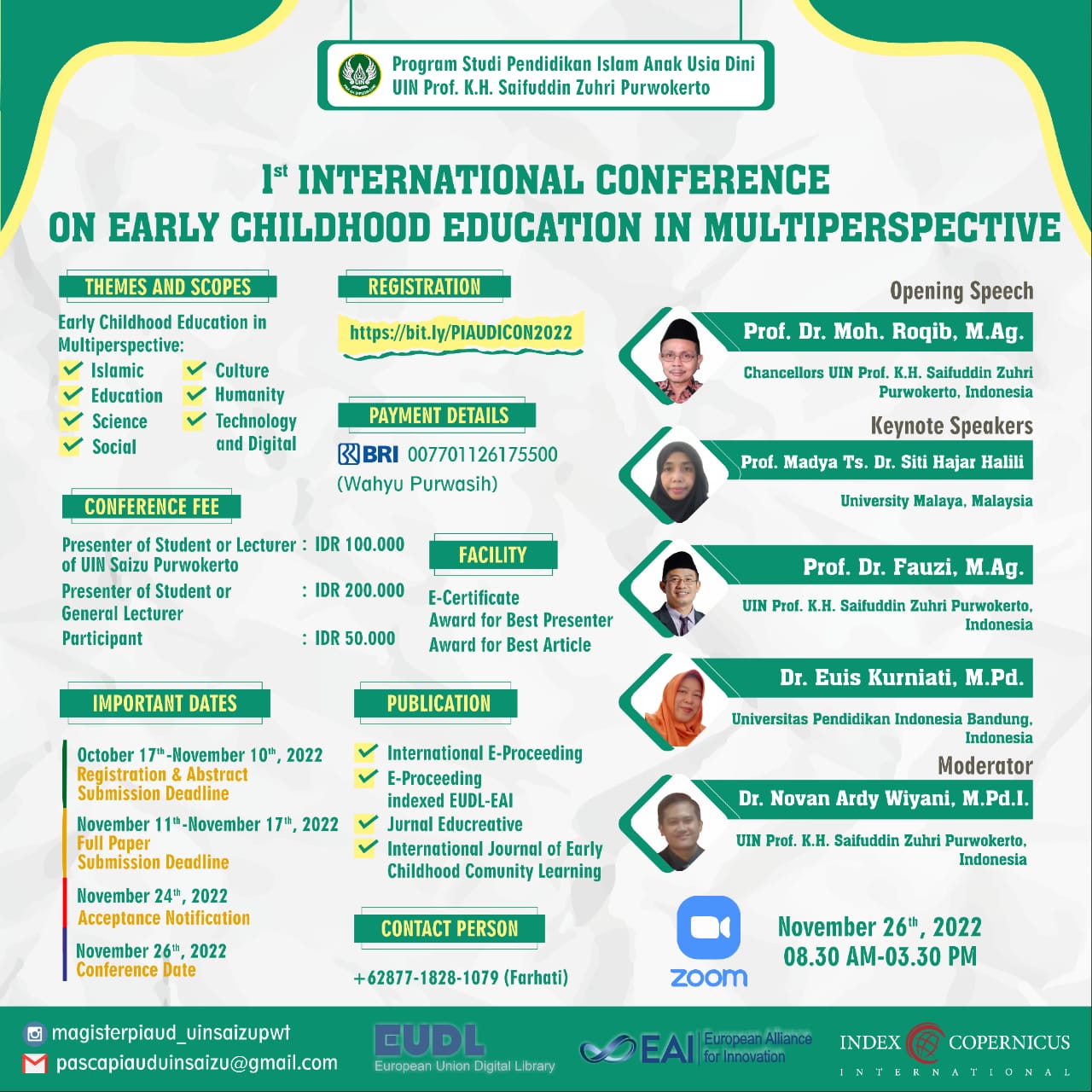
Copyright (c) 2022 INTERNATIONAL CONFERENCE ON EARLY CHILHOOD EDUCATION IN MULTIPERSPECTIVE

This work is licensed under a Creative Commons Attribution-ShareAlike 4.0 International License.