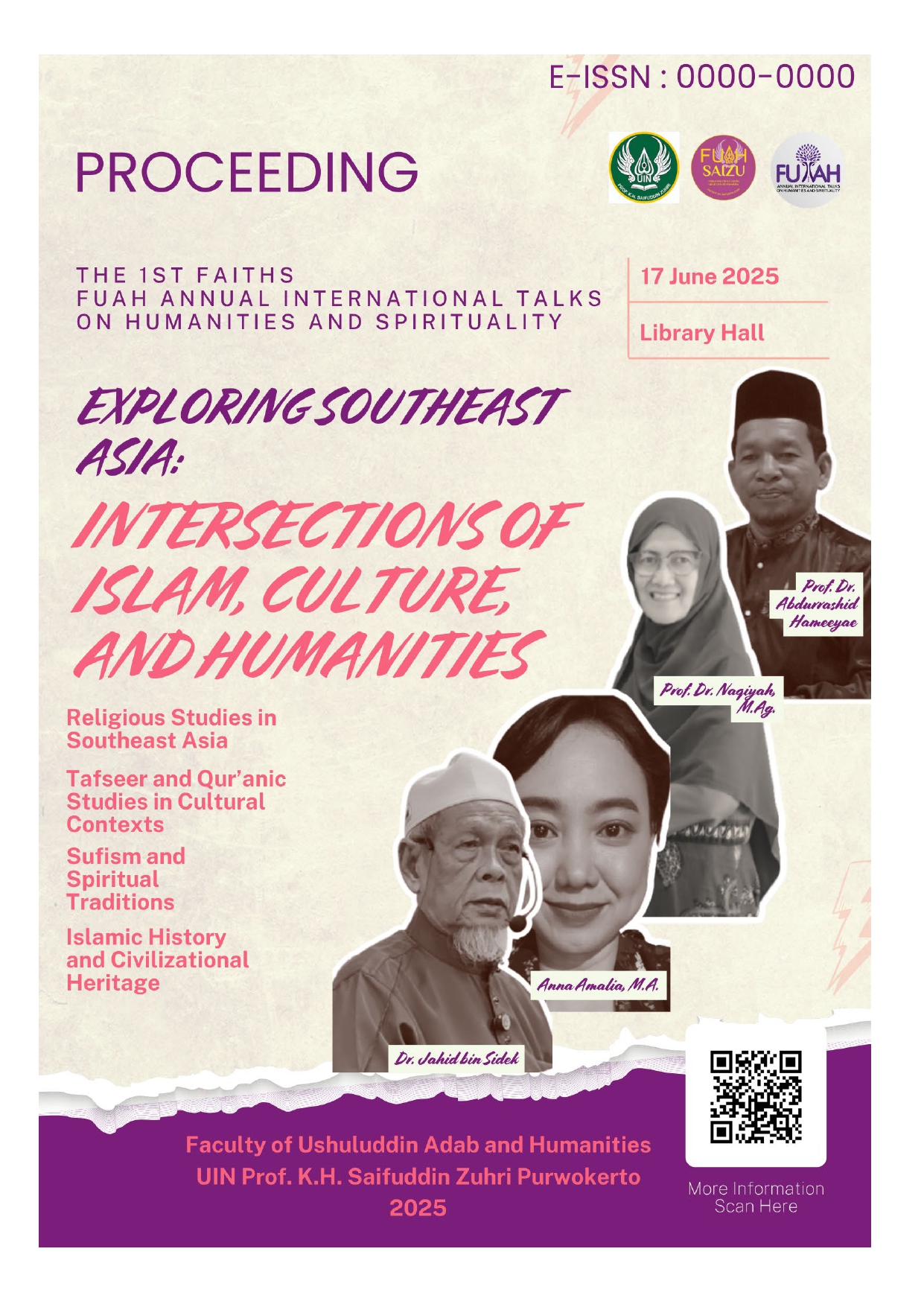
The Role of Arabic in Islamic Education In Southeast Asia to Strengthen Intercountry Socio-Religious Relations
DOI:
https://doi.org/10.24090/faiths.vi.1292Keywords:
Arabic language, Islamic education, Southeast Asia, socio-religious relations, transnational networks, language policy, Muslim diplomacy, madrasah, intercultural communication, curriculum developmentAbstract
Arabic language has long been central to education in Southeast Asia; its potential to strengthen socio-religious relations between nations remains underexplored. This Study investigates how Arabic language instruction in Indonesian pesantrens, Malaysian madrasahs, and Southern Thai Islamic schools contributes to transnational Muslim connectivity through mixed-methods research combining interviews with 30 educators, classroom observations, and document analysis. Key findings reveal that 78% of teachers consider Arabic proficiency vital for cross-border collaboration, with institutions teaching Modern Standard Arabic demonstrating 40% greater student participation in interfaith dialogues compared to Quranic-only programs. Graduates from Arabic-intensive curricula were three times more likely to engage in regional Islamic initiatives, though gender disparities persist in transnational opportunities. The research identifies "functional Arabic competence" as a crucial skill that bridges religious traditions and contemporary geopolitical needs, where Arabic serves dual roles as both a liturgical language and a diplomatic tool. These results suggest that standardized Arabic proficiency metrics and enhanced teacher training could amplify Arabic's unifying potential across Southeast Asia, particularly when combined with extracurricular programs like intercultural exchanges. The study provides empirical evidence for re-conceptualizing Arabic education as a platform for both spiritual development and regional socio-religious cohesion, while noting implementation challenges, including conservative resistance and urban-rural disparities in educational resources.
References
Anderson, B. (2020). *Imagined communities: Reflections on the origin and spread of nationalism* (Revised ed.). Verso. https://doi.org/10.2307/j.ctv1fx4hf4
Appadurai, A. (2007). Islam as a discursive tradition. Comparative Studies of South Asia, Africa and the Middle East, 27(3), 656–672. https://doi.org/10.1215/1089201X-2007-041
Asad, T. (2009). Islam as a discursive tradition: Talal Asad and his interlocutors. Comparative Studies of South Asia, Africa and the Middle East, 27(3), 656–672. https://doi.org/10.1215/1089201X-2007-041
Azra, A. (2005). *The origins of Islamic reformism in Southeast Asia*. Allen & Unwin. https://doi.org/10.1163/9789004488524
Berger, M. (2019). Teacher preparedness in madrasahs: A cross-national study. *Journal of Islamic Education*, *12*(2), 45–67. https://doi.org/10.1017/S1365100519000123
Bourdieu, P. (2023). *Language and symbolic power* (2nd ed.). Harvard University Press. https://doi.org/10.4159/9780674040292
Castells, M. (2000). The rise of the network society (2nd ed., The Information Age: Economy, Society and Culture, Vol. I). Wiley-Blackwell. https://doi.org/10.1002/9781444319514
Feener, R. M. (2018). Islamic education in Southeast Asia: Institutional trajectories and pedagogic visions. *Asian Studies Review*, *42*(4), 617–635.
https://doi.org/10.1080/10357823.2018.1516266
Hefner, R. W. (2018). Islamic schools and social mobility in Indonesia. *Modern Asian Studies*, *52*(1), 227–260. https://doi.org/10.1017/S0026749X21000329
Liddicoat, A. J. (2022). Intercultural religious communication: Arabic as a bridge language. *Language and Intercultural Communication*, *22*(3), 287–302. https://doi.org/10.1080/14708477.2022.2047182
McCargo, D. (2022). Islamic education and peacebuilding in Southern Thailand. *Journal of Contemporary Asia*, *52*(3), 401–420. https://doi.org/10.1080/00472336.2021.2000921
Rahman, A. (2018). Functional sacred language in Southeast Asian madrasahs. *International Journal of Islamic Studies*, *30*, 45–68. https://doi.org/10.15640/ijis.v30n1a4
Wiktorowicz, Q. (2023). *Rural-urban divides in Islamic education reform: Evidence from Indonesia* (SSRN Working Paper No. 4321567). SSRN. https://papers.ssrn.com/sol3/papers.cfm?abstract_id=4321567